Mini Course · Balance · Body Awareness · Primary Strengthening
Power Poses
6 Exercises for an Improved Topline
A topline isn't a position you ask for. It's what shows up when your dog has the muscle to hold it.
Lifetime access. Includes the companion ebook.
Where your dog's weight actually sits
Dogs carry roughly 60% of their weight on the front end and 40% on the rear — about 30% on each front leg, 20% on each back leg.
| 30% | 30% | 20% | 20% |
| 60% front assembly | 40% rear | ||
Your dog isn't a table with four even legs. Holding a neutral spine against that distribution is active work — and two jobs are happening at once. The major weight-bearing muscles of the legs hold your dog up. The smaller stabilizing muscles of the core keep the spine and pelvis from moving in ways they shouldn't. Multifidus, rectus abdominis, erector spinae, the internal and external obliques, transverse abdominus. Most of them sit deep, well beneath anything you can see.
Which is the honest answer to why posture training isn't posture practice. You can ask for a stand every day and not change the topline. The stand is the output. The muscles are the work.
A topline isn't one skill
Most fitness courses train one thing. This one draws from three separate blocks of the K9 Fitness Pyramid, because posture needs all three at once — take any one away and the topline goes.
|
Block 01 Balance & Stabilization Holding position on an unstable surface is what asks the deep stabilizers to fire, and keep firing. |
Block 02 Body Awareness Your dog can't place a foot correctly without knowing where that foot currently is. |
Block 03 Primary Strengthening Knowing the position isn't enough. Sustaining it under load is a strength question. |
What you get
Six exercises, plus a bonus exercise that needs no equipment at all. Every one of them is specified — not just demonstrated.
That means each exercise comes with written form checkpoints for the topline, head and neck, front feet, elbows, stifles and back feet. It means the signs of fatigue particular to that movement, so you know to stop before the form goes rather than after. And it means rep and hold counts for novice, intermediate and advanced, so the work progresses as your dog does.
Here is what that looks like on one exercise:
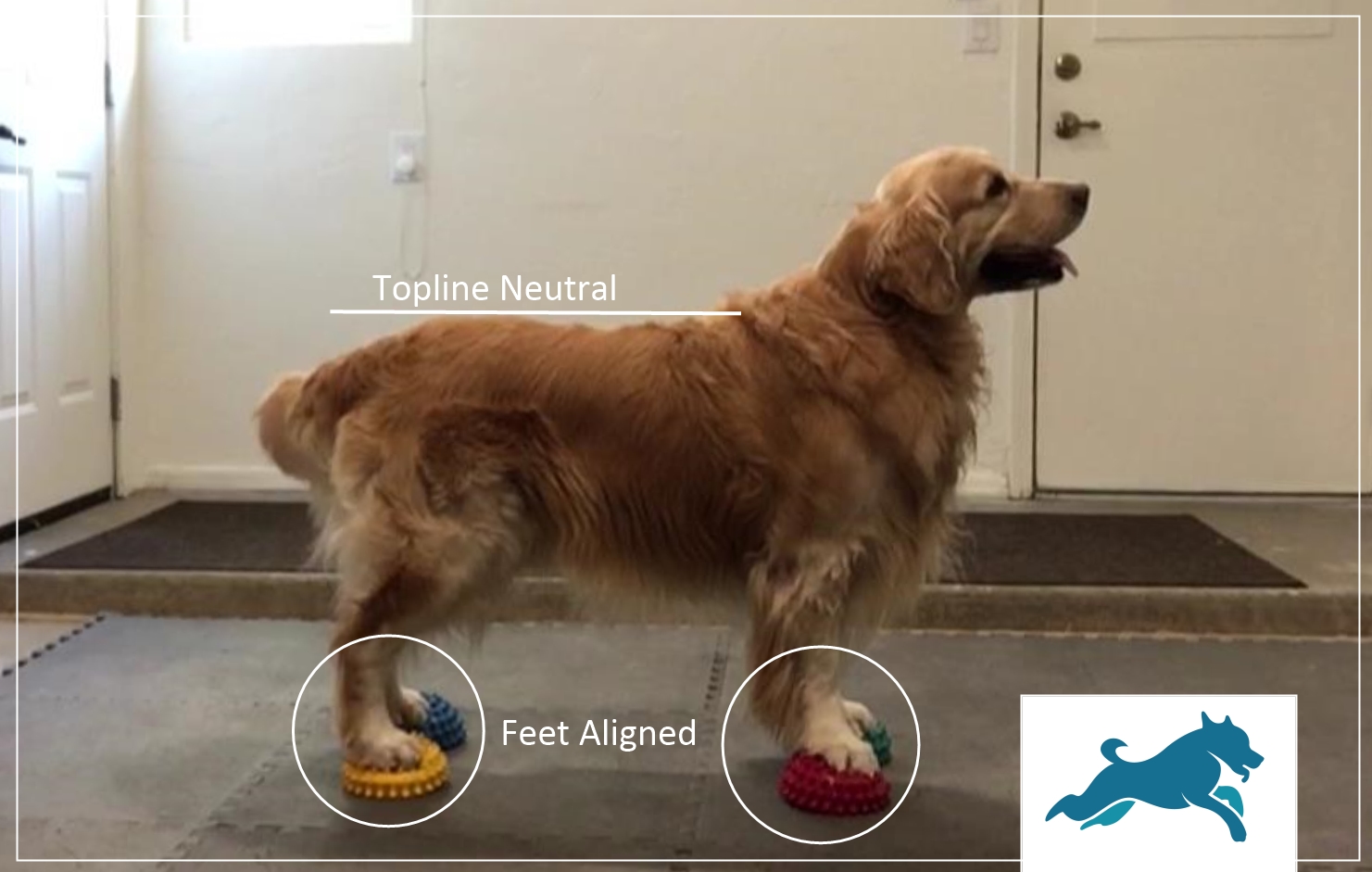
Annotated photographs accompany every exercise, marking exactly what to look at.
Also included:
- Video demonstration of every movement
- A companion ebook with all of it in one printable reference for your training space
- Lifetime access — buy once, come back to it whenever you and your dog need it
What you'll need
This is the most equipment-heavy of our mini courses. We'd rather you know that now than find out after checkout.
- A set of 4 paw pods
- 2 giant balance discs — an air mattress can substitute
- A platform long enough for your dog to stand on with all four feet — a step aerobic bench, or a Klimb without legs — plus a stable way to incline one end
- 2 stable platforms or blocks of equal height, 3–4 inches tall, sized so the front feet fit comfortably on one and the back feet on the other
- 2 K9FITbones, or 2 small balance discs
Every platform should be stable and have good traction on top. If yours are height-adjustable, 2 platforms will cover it.
Who this is for
Show and conformation dogs who need to hold a stack. Sport dogs whose performance depends on a topline that doesn't collapse under load. And any dog whose posture you'd like to be better than it is.
The exercises are appropriate for healthy adult dogs. If your dog has a current injury or a diagnosed condition, check with your veterinarian first.
Developed by Dr. Sonnet Jarvis, DVM, CCRT and Michelle Fromm, CCFT.
Build the topline, not the pose
Six exercises, filmed and specified, with the form checkpoints and fatigue signs that tell you what you're actually looking at.