Why Your Dog's Balance Improves Fast, Then Stops
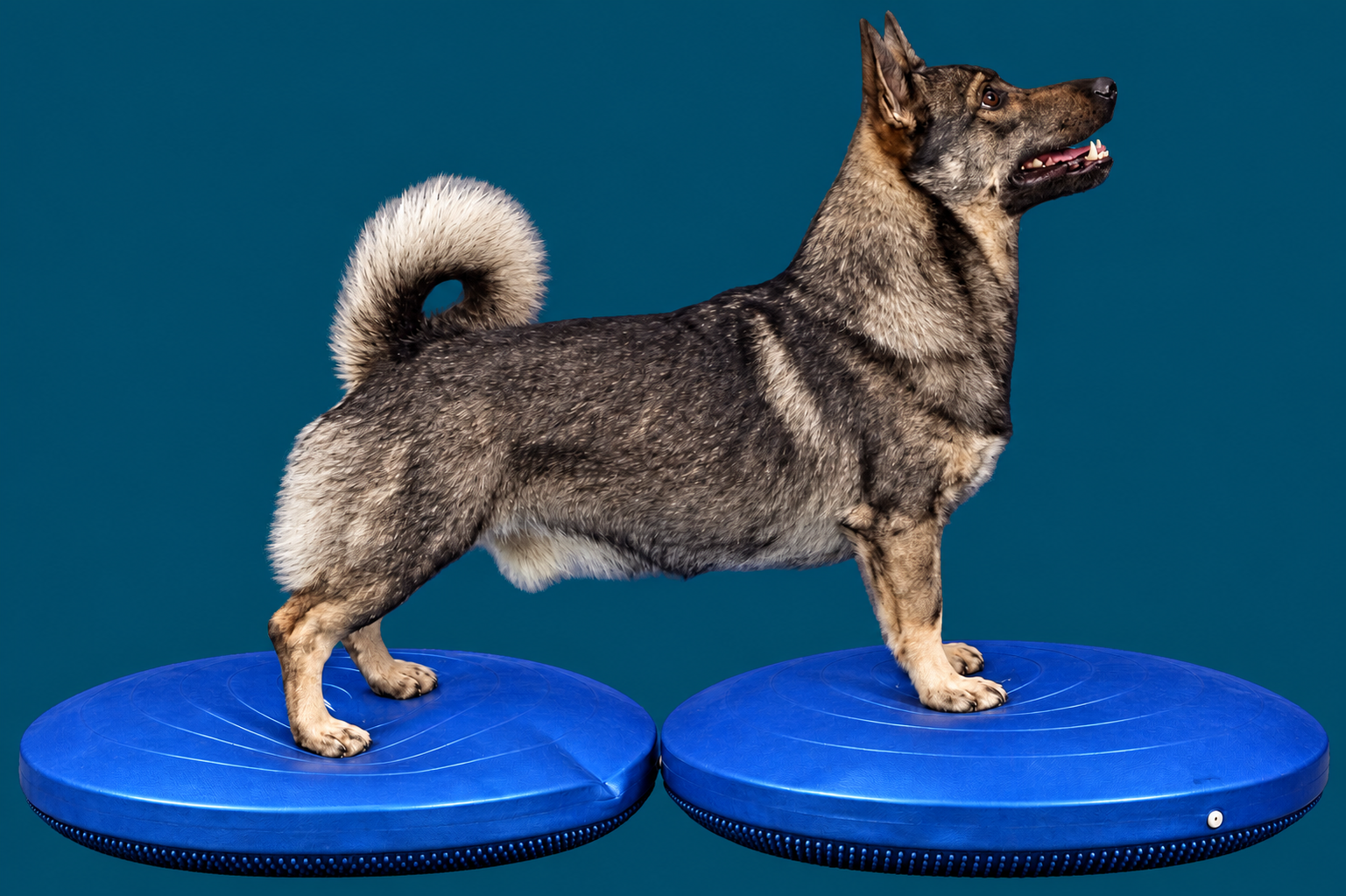
If you have done balance work with your dog, you have probably seen this pattern. The first couple of weeks bring real, visible progress. Then it flattens out. Same exercise, same dog, same equipment, and nothing seems to be changing.
Most people read that as the exercise no longer working but frequently it means something else. Balance improves faster than almost anything else we train, and then it plateaus, and both of those are expected. The reason is in how your dog learns a physical skill, and that learning doesn’t happen in a straight line.
Balance is a learned skill
As Dr. Sonnet Jarvis, DVM, CCRT, explains in her writing, balance is a learned motor skill with a genetic starting point. Some dogs are naturally well balanced and some are not, but every dog can learn to balance better.
This is possible because of neuroplasticity, the brain's ability to form new connections and reorganize existing ones. It is what allows your dog to learn a new motor skill and to keep it.
Balance itself is the result of three systems working together. The visual system is what your dog sees. The vestibular system, in the inner ear, senses the position and movement of the head. Proprioception is your dog's sense of where each leg and paw is without having to look. How much your dog leans on each of those changes as the skill develops, and that shift is a large part of why progress looks the way it does.
The three stages of learning a motor skill
Learning a motor skill happens in three stages.
- The cognitive stage. Your dog is working out what the goal is: stand on this, stay on it. Your dog relies heavily on what it can see, and there is a lot of trial and error. This is the fast stage, and most of it happens inside the training session itself.
- The associative stage. Your dog knows what to do and is working out how to do it well. The movement gets refined. The gains are smaller and they build across sessions rather than within one. Your dog relies less on its eyes and more on what it feels through its joints and muscles. Your dog becomes less dependent on looking and more skilled at sensing where its body is.
- The autonomous stage. The movement is close to automatic. Your dog can produce it in almost any environment with very little thought.
The fast progress you saw at the start was the cognitive stage. The flattening is usually the associative stage, and that is where the real refinement happens.
Why the progress is not a straight line
Those three stages describe how the skill develops. Encoding, consolidation, and retention explain how your dog learns and keeps it.
- Encoding. The experience is converted into something the brain can store. Most of this happens during the training session.
- Consolidation. This happens between sessions, and sleep is when most of it takes place.
- Retention. The skill is committed to muscle memory, so your dog can call it up without having to think about it.
Motor learning is not linear. You see large improvements early, smaller ones later, and flat stretches in between. Evidence in motor learning indicates that consolidation for long-term storage carries on during those flat stretches. Your dog has not stopped learning. The skill is still being stored, even when you cannot see it in the training session, and plateaus are often followed by another period of improvement.
What to do when your dog plateaus
If your dog has stopped visibly improving, that is usually the associative stage doing its work, not a reason to change the exercise.
Keep the setup the same: the same piece of equipment, the same position, the same surface. If you change everything at once, you will not be able to see the improvement when it comes back, because you will have nothing to compare it to.
Write it down
Plateaus are hard to judge from memory. A change that is small from one session to the next is easy to miss, and easy to mistake for no change at all.
That is what our free K9 Fitness Journal is for. Record what your dog can hold, on what, and for how long, and you will see the plateaus instead of guessing at them. It is free at k9fitsolutions.com.
Balance and stabilization form part of the foundation of the K9 Fitness Pyramid, developed by Dr. Sonnet Jarvis, DVM, CCRT, and Michelle Fromm, CCFT.